The next time you turn on your tap, think backwards.Imagine rewinding the journey of the drop of water in your hand. It flows back through the pipes in your home, beneath the streets, past treatment plants and pumping stations, until it returns to the river or reservoir where it first entered the system. That single drop tells a story: not just of where the water came from, but of how it arrived in your tap. It is a story of infrastructure transforming legal entitlement into lived reality.
But what if the drop never reached your tap? What if the right to use that water existed, but the canals, pipelines, and pumps needed to deliver it did not? In the Colorado River Basin, water is often discussed in terms of rights to acre-feet, allocations, and shortage agreements. But on the ground, water only exists if it can be moved. For many Tribal Nations, legally recognized water rights do not automatically become water flowing to homes, farms, or communities. Tribal water rights are federally reserved rights that were established when the U.S. government created Indian reservations, which recognizing them as some of the most senior water rights in the Colorado River Basin. Although these rights are legally protected, the amount of water each Tribe is entitled to use must be quantified through lengthy legal processes, leaving many rights unresolved or only recently confirmed.
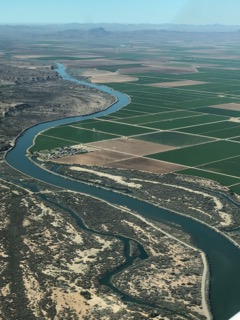
Colorado River Mainstream by Amy McCoy
Over the past several decades,
Tribal water rights have been quantified
through negotiated settlements with federal and state governments. These
agreements confirm legally reserved water rights and specify how much water a
Tribe is entitled to use. Yet a settlement alone does not deliver water.
Bridging the gap between legal entitlement and physical access requires canals,
pipelines, pumps, and treatment systems. It is through this infrastructure that
water policy becomes reality.
Making water rights usable requires infrastructure. In Arizona, the Central Arizona Project (CAP)—a 336-mile network of canals and pumping plants that carries Colorado River water to central and southern Arizona—is one of the key systems that transforms legal rights into physical water delivery. Without infrastructure like CAP, many Tribal water rights would remain “paper water”: legally recognized but practically inaccessible. Building this infrastructure is a long process. Planning, funding, permitting, and construction can take decades, leaving many communities in the space between legal recognition and practical access.
As the Colorado River faces increasing pressure from prolonged drought and climate change, this distinction matters. Native American households face the greatest disparities in access to piped water services in the United States. For many families on the Navajo Nation, running water is not a given. An estimated 30-40% of residents lack piped water, relying instead on costly hauled water—a reality that has contributed to persistent health disparities and amplified the impacts of the COVID-19 pandemic.
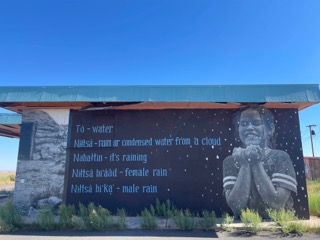
Language of Water Mural by Amy McCoy
Infrastructure is therefore more than
engineering; it is a form of water governance. It determines whether legal
rights become lived realities and will play a defining role in how Tribal water
rights, and the Colorado River itself, are managed in an increasingly
water-scarce future. And behind every pipe is a question of equity: who gets
water, and who still waits?
Alice Le Bihan – Western Resource Fellow | Alice Le Bihan is an environmental law and policy scholar who calls the Canadian West Coast and its 17,000 miles of coastline home. She holds a BA in Political Science and French from the University of British Columbia, and a JD with a concentration in Environmental Law and Sustainability from the University of Victoria. Before Yale, she supported Indigenous watershed governance through land- and community-based research, public interest environmental law work, and contributions to a landmark Indigenous land and fishing rights case. At the Yale School of the Environment, she is expanding her interdisciplinary expertise in watershed science and restoration, with the goal of advancing resilient water governance through legal, bilateral, and international collaboration. See what Alice has been up to. |Blog