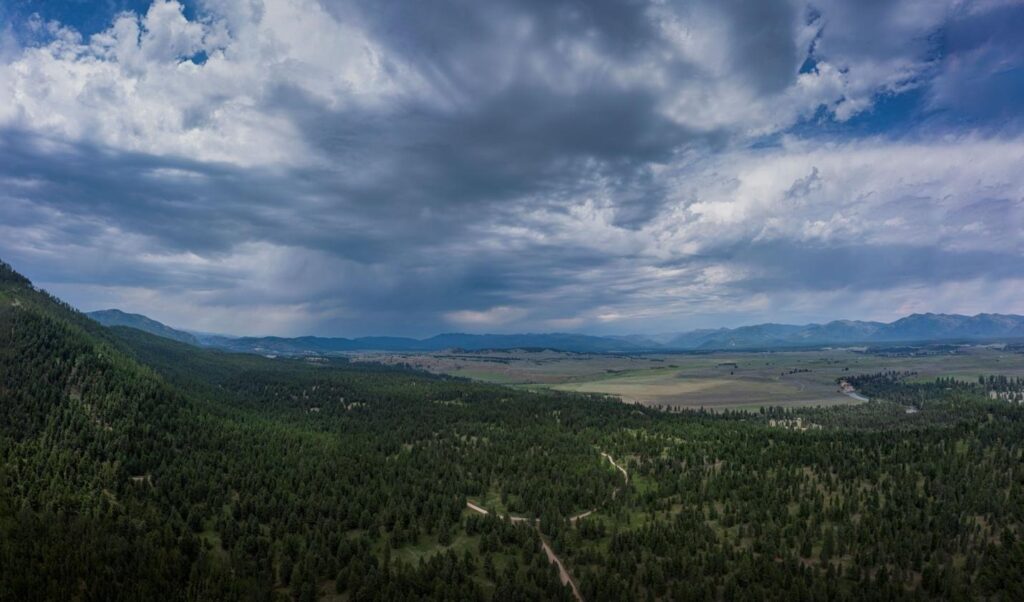
During the 2025–2026 academic year, I am working with fellow Ucross researcher Salma Huque to evaluate the economic benefits of the Blackfoot Challenge’s public and private investments in nature conservation within the Blackfoot watershed. The Blackfoot Challenge (BC) is a conservation nonprofit based in Western Montana that collaborates with local landowners to advance long-term stewardship of the Blackfoot watershed region.
This research experience has significantly strengthened my problem-solving skills, particularly in translating a complex and vague question into measurable actions, collecting data under availability constraints, making reasonable assumptions, building an economic model from scratch, and communicating results clearly to diverse stakeholders. Equally important, the project has engaged me with multiple industry experts. I gained valuable insights into land conservation initiatives in the Western United States, organizational management, and public–private stakeholder coordination from Seth Wilson (Executive Director) and Jennifer Schoonen (Communications & Development Director). I worked closely with Lynn Job (Director of Finance & Grants) to source and interpret financial data for my economic model. I also collaborated with Cindy Super (Forestry & Prescribed Fire Coordinator) to deepen my understanding of BC’s forestry stewardship initiatives, particularly its wildfire mitigation programs.
Photo Credit: Jeremy Roberts
I have also deepened my understanding of the importance of public–private collaboration in land conservation. The absence of either party can significantly undermine conservation outcomes. In my home country, China, land-use planning and conservation are largely managed by public entities, with limited involvement from nonprofits or private organizations. Individuals express dissatisfaction with poorly managed parks and public spaces, yet meaningful collective action is limited, and increasing intensity of pollution persists. By contrast, in western U.S. states like Montana, land conservation is supported by a robust network of nonprofit organizations, substantial public funding for land stewardship programs, and significant matching private investment and labor. This coordinated structure not only mobilizes capital but also attracts talent. Notably, many highly trained land conservation professionals, including experts with graduate degrees and experience, choose to give back to the communities to support land stewardship and nature conservation.
What attracts me most to the Blackfoot Challenge is its unwavering commitment to speak for the Blackfoot watershed community. Seth treats landowners not as stakeholders but as family members. He consistently stands up for community rights and spares no effort in connecting landowners with the resources, knowledge, and institutional support they need to manage their land sustainably. This people-centered approach teaches me that effective conservation is not only about ecological outcomes or economic efficiency, but about trust, persistence, and long-term relationships rooted in place.
Owen Luo – Research Assistant | Owen is a Master of Environmental Management candidate at Yale School of the Environment specializing in energy and policy. He is passionate about the intersection of clean energy and finance, with experience as a project finance analyst at a utility-scale renewable energy developer and as an investment banking intern supporting a solar energy transaction. He is also the founder of a renewable energy nonprofit that promotes public understanding of clean energy adoption. Owen holds a B.S. in Applied Mathematics and Economics from Columbia University. Originally from Chengdu, China, he enjoys playing soccer, hiking and photography. See what Owen has been up to.